
Siting Invisible Values
Intersecting Qualitative and Quantitative Evaluation at the Parcel Scale
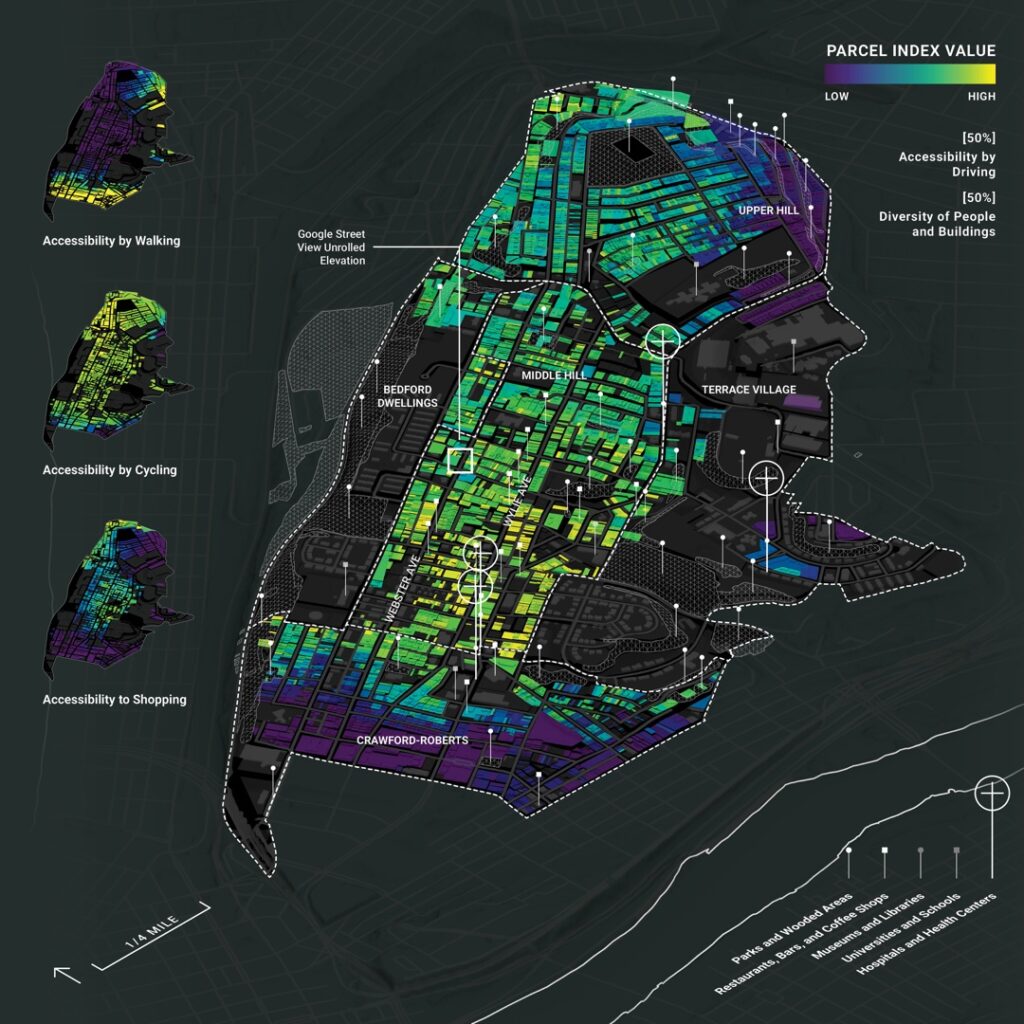
Can statistical methods such as factor analysis enable a more sensitive qualitative understanding of, and design response to, urban places at the parcel and block levels?
This research explores the intersection of quantitative and qualitative methods for identifying the character of a given site. A corollary web-based tool enables policy-makers, local residents, and small-scale housing developers to explore sites for small-scale housing development based on factors relevant to urban quality, access, and carbon emissions. The practical goal of the research is to support incremental gap-filling in our urban fabric by: 1) making visible overlooked or unseen opportunities for housing in areas that will decrease vehicle miles traveled and improve the lives of residents, and 2) to make legible the invisible factors that contribute to the cultural, physical, and environmental value of a place by opening up the analytic method for self-weighting by users based upon their individual value system. The research bridges planning level concerns around the existing conditions and future location of housing with site level concerns over the design of future housing and unit types in relation to the immediate physical and cultural context.
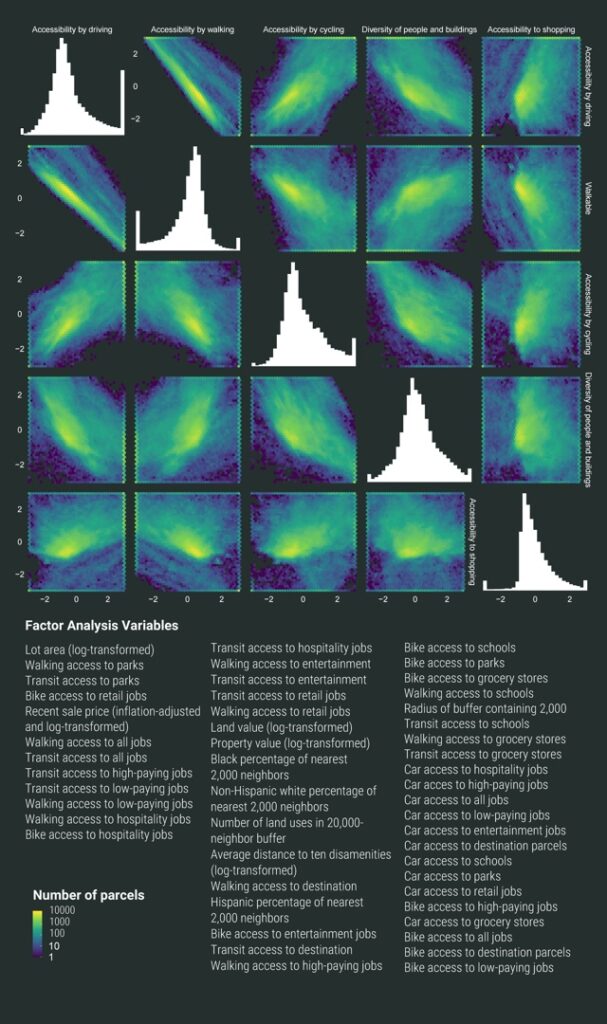
A statistical method called factor analysis is used to explore the possibility of quantitatively identifying the disposition and character of a site at the parcel level. Factor analysis is used to extract a set of five independent factors describing the attributes of a site from a set of fifty variables.
An important capacity of this research is the ability to highlight places that are highly proximate to jobs and urban amenities and yet less accessible, based upon key metrics of access, than areas that are more distant. For example, historically Black neighborhoods like the Hill District of Pittsburgh host a strong and connected street grid, proximity to jobs and parks, and a diverse range of uses, urban form, and residents demographics –all elements that contribute to urban quality. However, when valued based upon walkable access to amenities such as transit and shopping, they return a low score. This is a visualization of historic disinvestment in the neighborhood. Automatically scraped internet street views are analyzed to show the visible and visible factors that contribute to the disposition of a place.


Principal Investigators
- Elizabeth Bowie Christoforetti
- Carole Voulgaris
Researchers
- Mark Heller
- Ana Merla
- Tianyu Su
- Leah Welch
Output
Exhibition: Our Artificial Nature: Design Research for an Era of Environmental Change. Gund Hall, Harvard Graduate School of Design, Fall 2024.