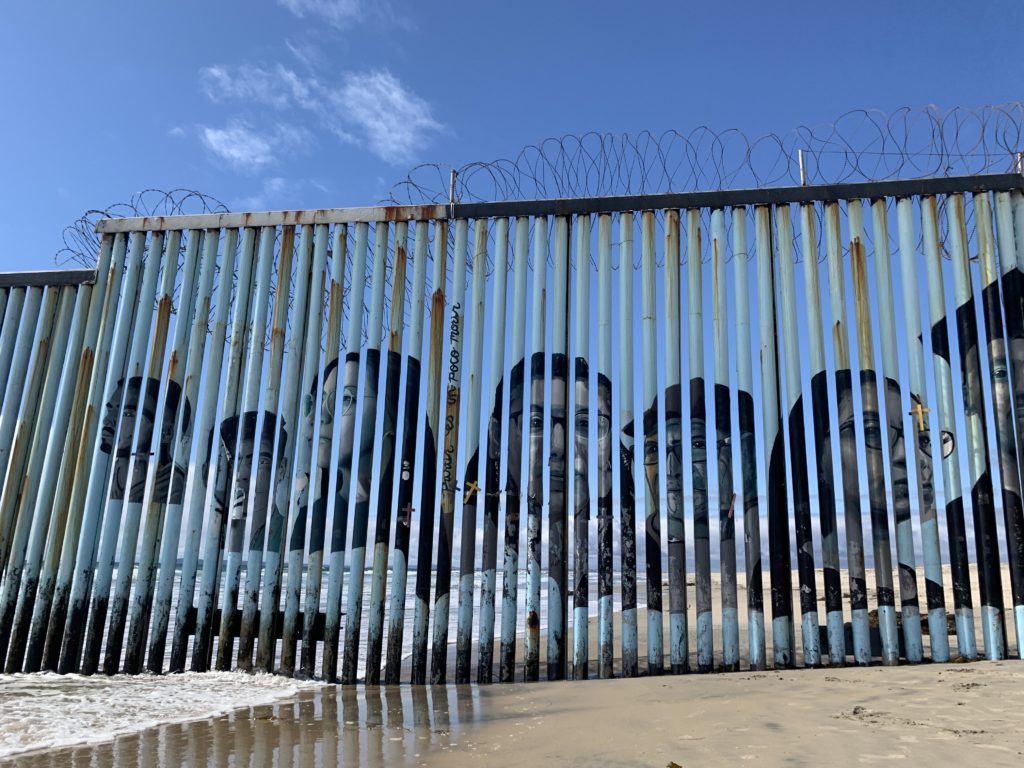
Sorry for Trespassing: A Layman’s Defense of Walking Urban Edges
Feike de Jong is a Mexico City-based journalist, author, artist, and photographer focusing on urban spaces. He has written for the Guardian, Bloomberg Citylab, Monocle, Fortune International, Expansión, Arquine, and the NRC Handelsblad among others. He has done projects walking around the edges of the Greater Mexico City Area, Kigali, Rwanda, and the San Diego-Tijuana Borderplex. He has also collaborated with organizations such as the Universidad Nacional Autónoma de México (UNAM), the Rufino Tamayo Museum, the Universidad Autónoma Metropolitana (UAM), York University in Toronto, and Ogino Knauss in Berlin. In 2010, Feike won the Walter Reuter prize for journalism for his coverage of climate change in Mexico.
Borde(r) was made possible by the Steunfonds Freelance Journalisten of the Netherlands. Special thanks to Edwin Koopman of Bureau Buitenland of the VPRO Radio in the Netherlands, Duilio Rodríguez of Pie de Página in Mexico City, photographer Gustavo Graf of Mexico City, and the collective Dignicraft of Tijuana.
—
Interviewer: Where are we now?
Informant: Casa de Oro.
Interviewer: And what makes Casa de Oro different? What distinguishes it?
Informant: Well the name of course.
I. In October 2020 I tried to walk around the edge of the Tijuana-San Diego metropolitan area. I say tried because on the ninth day of the walk around Tijuana I was interrupted by men with arms and radios inducing me to flee the city. Later in San Diego, injuries forced me to twice take public transport for small stretches along the coast. Aside from these imperfections, I walked continuously as well as I could where city meets countryside, advancing between 20 and 30 kilometers a day, staying in hotels on the periphery, taking photos, falling into conversations, eating whatever was at hand and taking in the urban landscape.
But before discussing this experience I would like to clarify what I mean by the edge of a city and why I find it interesting
Sorry for trespassing: A layman’s defense of walking urban edges
For my purposes the edge of a city is the shortest route passing through at least 100 meters of open country around a given city. If there is building more than 100 meters out it is, as far as this definition is concerned, outside the city. Open fields enveloped by the city are, according to this definition, inside the city. Though this definition is arbitrary it is roughly applicable to the definition of urban agglomeration used by the UN, namely a kind of contiguous settlement.
In the field 100 meters is a distance, which is easy for most people to estimate and walk. It also allows for the spatial comparison of urban infrastructures, such as highways entering the city, according to a fixed measure. As an algorithm this definition generates a spatially precise edge for any settlement. Applying this criterion, I have at the time of writing walked around the Greater Mexico City Area, Kigali in Rwanda, Tijuana, and San Diego.
The edges of cities are like their fingerprints. When you walk along the edge of a city you are constantly running into the city’s strategic infrastructure. High-tension lines, highways, nurseries for plants, garbage dumps, recycling plants, prisons, military bases, airports, junkyards, cemeteries, universities, suburbs, and gated communities are all phenomena which I associate with the edge of cities and which repeat themselves over the landscapes of different cities, almost forming a vocabulary.
Just like the pyramids tell us about their builders, we can examine the material culture of the edges of our growing cities to better understand what drives us. In the end this project is a kind of archeology of the anthropocene, observing that space where we are materially expanding and trying to understand the builders.
II. The Tijuana-San Diego Borderplex is a rare example of an urban agglomeration split between Global North and Global South.
According to the UN, San Diego had a population of 3.2 million in 2018 and will grow to 3.5 million by 2030. Meanwhile, Tijuana had a population of 2.2. million in 2018 and is expected to grow to 2.5 million in 2030. The two cities are connected at the border crossings of San Ysidro in the west and Otay Mesa in the east, from where a spidery web of residential neighborhoods and factories connect to Chula Vista, Eastlake, and greater San Diego.
According to US government data, 70,000 cars and 20,000 pedestrians cross from Tijuana every day at the world’s fourth largest border crossing in San Ysidro. Many of the maquilas in Tijuana export their finished products directly north. Many have administrative and operational offices in San Diego and in fact San Diego itself has very little manufacturing capacity, as if its manufacturing has been outsourced to Tijuana. Tijuana is isolated from the Mexican energy grid and connects to San Diego. The money, arms, and even the ideology fueling Tijuana’s bloodshed come from the north.
Significantly, Tijuana lies very far from other large Mexican cities in a remote corner of the urban system. People in Tijuana measure relative to San Diego, whereas in many other parts of Mexico being successful implies being successful relative to Mexico City. I imagine most people in Tijuana would feel more culturally comfortable in San Diego than in most of Mexico.
Instead of two different cities I tried to imagine Tijuana as a district in a larger urban constellation, as if it were a strange peripheral neighborhood of one big city. In that sense I hoped that perhaps the asymmetries between Global North and Global South would be visible as metropolitan problems. I decided to try to forget about the United States and Mexico and to think about the Tijuana District of San Diego Center.
In Tijuana District, daily water consumption per capita is 204 liters per day[1]. In San Diego Center it is 492 liters per day[2], despite the fact that they share the same hydrological basin. Credit is much easier to get in San Diego Center and the average citizen has a debt of $75,000 USD[3], 77% of which is to pay for mortgages on houses. In Tijuana District less than 5% of all credit is for mortgages and the average citizen has a debt of $1,300 USD[4] of mostly consumer debt.
In Tijuana District the average income per household was approximately $3,000 USD per year in 2018[5] while in San Diego it was $68,000 USD[6] per year. Understandably, movement between Tijuana District and San Diego Center is restricted and only 3%[7] of the district’s population is allowed to cross to San Diego Center.
It is much easier for people to get to Tijuana District than to San Diego Center. Thousands of migrants are constantly seeking housing in Tijuana District in the hope of getting to San Diego Center. The district administration takes care of this growth by letting people build dwellings themselves and grudgingly bringing in services – or leaving the whole problem to developers.
The district administration is historically notorious for corruption. The police are badly paid, badly trained, and easily infiltrated. Alcohol was legal during the prohibition era and the district has been influenced by organized criminals from San Diego. Just as it is easier to bring people to Tijuana District than to San Diego Center, it is also easier to bring illegal substances there. These illegal substances are then transported to San Diego Center where they are redirected and sold on the black market. As San Diego Center cannot seem to stop the crossing of these illegal substances in its own territory, part of the money from this illegal trade accumulates in Tijuana District.
Competition in this lucrative illegal business is fierce, the stakes are high, and the market is fragmented. The actors are criminals. The chances of being caught for murder are much lower in Tijuana District. And so a wave of mutual killing breaks out. Because the different actors fear for their lives, they create strongholds within Tijuana District where it is difficult to approach them. They arm, organize and evolve.
While San Diego Center has the largest concentration of military assets on earth[8], its Tijuana district was the second most violent city in the world in 2020[9].
—
III. The edge of Tijuana sprawls over arid, eroded landscapes, full of ravines and steep hills. Car tires are everywhere, holding up fragile slopes bare of vegetation. The sun beats down on crumbling, pale earth, pretending to be rock but falling apart when you grab it. Tenuous streams of untreated water can be found at the bottom of little ravines where abruptly an almost tropical vegetation of banana and palm trees sprouts up surrounded by jerry-rigged houses of wood and concrete. The country edge is mostly rock and dirt, with the occasional cottontail hare bounding over through the low brush, a vulture soaring above. The sky is intensely blue and the light is startlingly clear.
Compared to the edge of the Greater Mexico City Area, the edge of Tijuana is uncomfortable to walk. There is less commerce, fewer hotels, and places to eat are harder to find. The landscape is harsh, hot, and dry and the scenery is vivid and post-apocalyptic.
Aside from a flat stretch eastwards along the border from the airport to the Otay Mesa full of lots for trailers and boxy maquilas and the small beachfront area, the edge of Tijuana is all hilly. Particularly to the southwest, Tijuana is dispersed over ridges and valleys where flat land is hard to find. In some ways the urban structure in that part, with its many social housing units, resembles San Diego, with parkway like avenues lined by sloping embankments connecting fragmented housing projects.
But a lot of the walking is also in the countryside, beyond the freeways ringing the city. There are slopes on the hills in and around Tijuana, which seem completely devoid of life, all rocks and gravel.
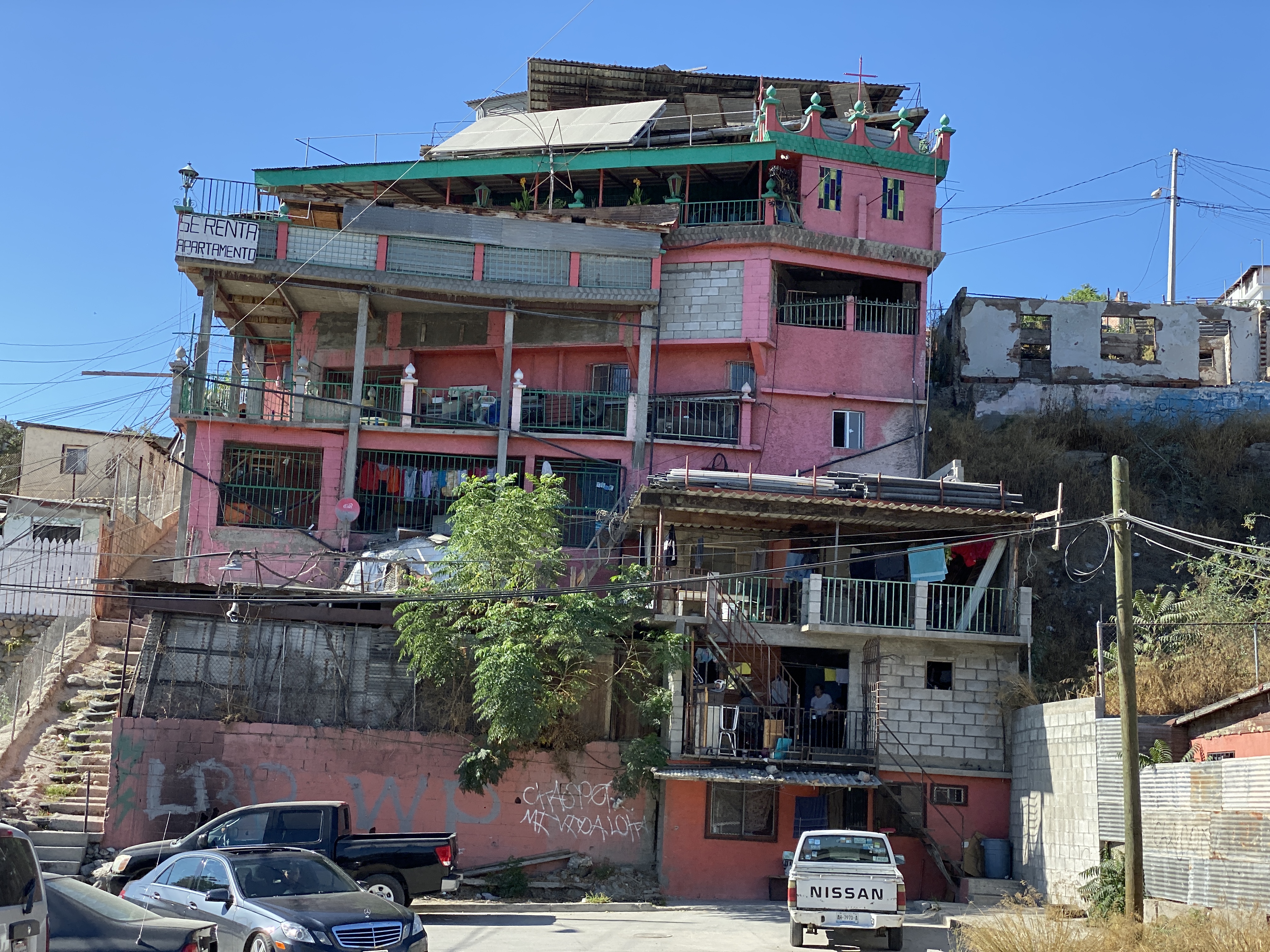
Tijuana’s edge is mostly composed of either self-built housing in various stages of consolidation, social housing units with tiny accommodations in various stages of decay, or maquilas and their logistical support. Compared to the edge of Mexico City, housing is shoddy. The social housing units are smaller and seem to be falling apart even faster. The self-built housing teeters more ominously and seems more crooked. The dogs are more ferocious.
The dynamic of self-produced housing in Tijuana marks an important difference with San Diego. Many Mexicans cannot access a mortgage and therefore cannot buy a ready-built house. So instead of paying interest they pay to build up a house on land they have somehow acquired. This process can typically take from 10 to 30 years, but then many Mexicans do have a house, which might be in some ways a better value than houses bought with a mortgage when they are finally paid off and starting to fall apart.
The self-built housing in Tijuana uses more wood and plywood than in central Mexico. This seems to be inspired by the houses of San Diego, which are often made of sheets of plywood over wooden frames covered with stucco.
Social housing seems to function as a reservoir for formal workers who can pay mortgages by receiving maquila salaries. Houses are often tiny and many are visibly decaying. Buses bringing the workers back and forth to the clean generic maquila factories in their grey boxes complete the circuit through the ragged city.
In any case many Tijuanenses hope the border will be a temporary stop on the road to San Diego, and do not seem to want to get overly invested in real estate.